**Another academic and erudite Portuguese film… yet more tolerable than many others I've seen.**
Despite considering myself a patriot, I recognize that Portuguese cinema is not particularly good when compared to Spanish, French, Italian or British cinema. We simply don't have the capital and people to make movies as good as theirs. As I've said in other reviews I've written, Portuguese cinema ends up focusing on two distinct fields: bad taste comedies with strong popular appeal, and academic, erudite and not infrequently unpalatable films that (almost) never leave the "festival circuit".
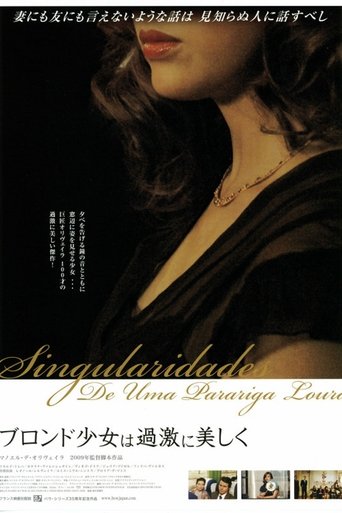
The film that brings us here is a small work directed by Manoel de Oliveira, a dean of filmmakers who gained a very good reputation, but who does not seem to have ever achieved international recognition at the height of what he deserved. In fact, and as much as I may sometimes criticize him, and disagree with his style or options, Oliveira was a good director and a man who understood and lived cinema like very few others. And the proof is the fact that he released this film at the age of one hundred years old!
The script is strictly based on a short story by Eça de Queirós, one of the greatest and most notable Portuguese writers, and was conceived as a light romantic comedy. So light that it didn't make me laugh for a single minute! Personally, I see it more as a moral melodrama. What we have here is, basically, the ravaged infatuation of an emaciated, gentle secretary with a young blonde woman who appears to be just as gentle, docile, and characterless as he is. She is the archetype of the ethereal, angelic and apparently perfect woman who, in the 19th century, was well considered for society. He will, by various means, try to make enough fortune for the marriage, even going against his uncle, who had him as an employee in his trading house.
The film is reasonably good. It could be better if it was a little more spirited (it's supposed to be a comedy, right?) and if certain attitudes and mannerisms of the characters had been somewhat updated and modernized. Set in the present days, there is no justification for how those characters talk and behave as if they were in 1850! That whole question around the fan, for example, sounds archaic. What is the young woman who, nowadays, always carries such an object with her? Another situation that doesn't seem credible to me is the whole opening sequence, on the train. I know that train travel is quite likely to lead to strange people starting to talk to each other. However, I think it would be more coherent and credible, for example, for the character to vent what he needs in a bar, after a few drinks. It sounds more up-to-date, and more coherent with the character's posture, who is experiencing a strong personal pain.
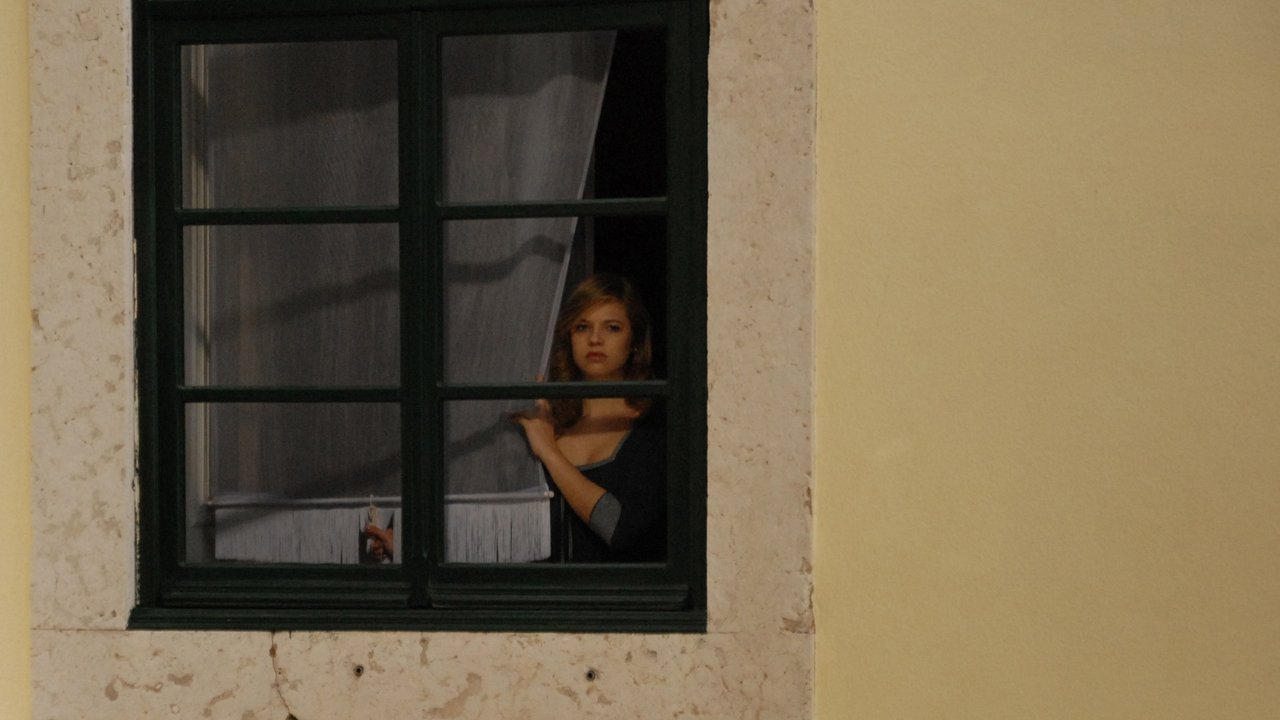
The film counts with the participation of a series of good Portuguese actors, with a considerable accolade in theatre, television and cinema. Catarina Wallenstein seems like a good choice for the female lead. She was quite young, and managed to give that little blonde a sweet and docile look. Ricardo Trêpa, grandson of director Oliveira, doesn't seem to have been a bad choice to play the young lover either, even though he is somewhat unknown. Diogo Dória, Luís Miguel Cintra and Leonor Silveira provide welcome support.
Technically, the film bets heavily on cinematography. Oliveira, with a watchful eye, uses camera movements and the framing of the scenes to convey to the audience the feeling of absolute idealization and deification of that blonde girl, for us to see her as her suitor saw her. The film was made in Portugal, of course, and makes good use of the filming locations, as well as the train journey (this is the second time that I have seen a train play such a prominent role in the opening of an Oliveira film). However, it is a film that loses a lot due to its lukewarm pace, the absence of any emotion, the excessively paused narrative and the absolute absence of a soundtrack.