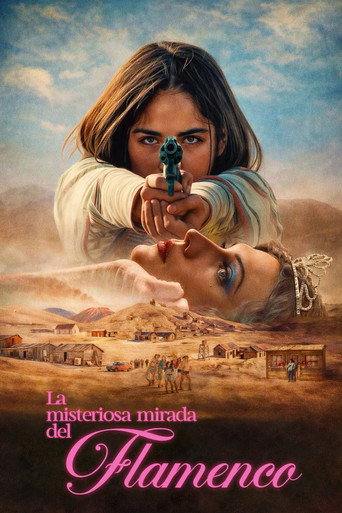
Women are in very short supply in this Chilean desert mining community whereas gay men seem far more common! Fortunately, there appears to be an equilibrium between "Don Clemente" (Luis Dubó) and his working men and "Mama Boa" (Paula Dinamarca) who holds sway over the no-nonsense "transvesti". Things start to go wrong with this balance in the early 1980s when a mysterious plague starts to affect the population. Highly superstitious, the locals begin to believe that it can only be spread by gazing into the eyes of an homosexual. Watching these changes in attitudes is eleven year old "Lidia" (Tamara Cortés) who sits squarely in the middle amidst these increasingly polarising camps and through her friendships acts as a conduit for our own observations of just how the behaviour of this small, actually quite tightly knit, society alters. The miners are not inherently intolerant nor violent; they are not killers or brutes - but they are afraid and so their solution - that the the gay folks have to wear blindfolds - may seem impractically ridiculous, but is still quite remarkably measured. What now ensues is an hybrid of the romantic, the lightly comedic and the fantasy and whilst it does play to stereotype, it does that in quite an ingeniously unusual fashion - especially given the hostility of their arid and unforgiving environment. There are sub-plots galore going on that suggest previous encounters, lost loves and even "Lidia" herself proves that she's not above having her own axe to grind as the tension in this town vacillates between the joyously optimistic and the down right dangerous. The pacing isn't the best, and there appears to be too much on auteur Diego Déspedes's drawing board for him to do justice to all the topics and characters he introduces, but Cortés, Dinamarca and Matías Catalàn's considered contribution as "Flamenco" present us with a characterful study that seemed perfectly fitted to a part of the world where so many of their troubles were as imported as they were unwelcome.