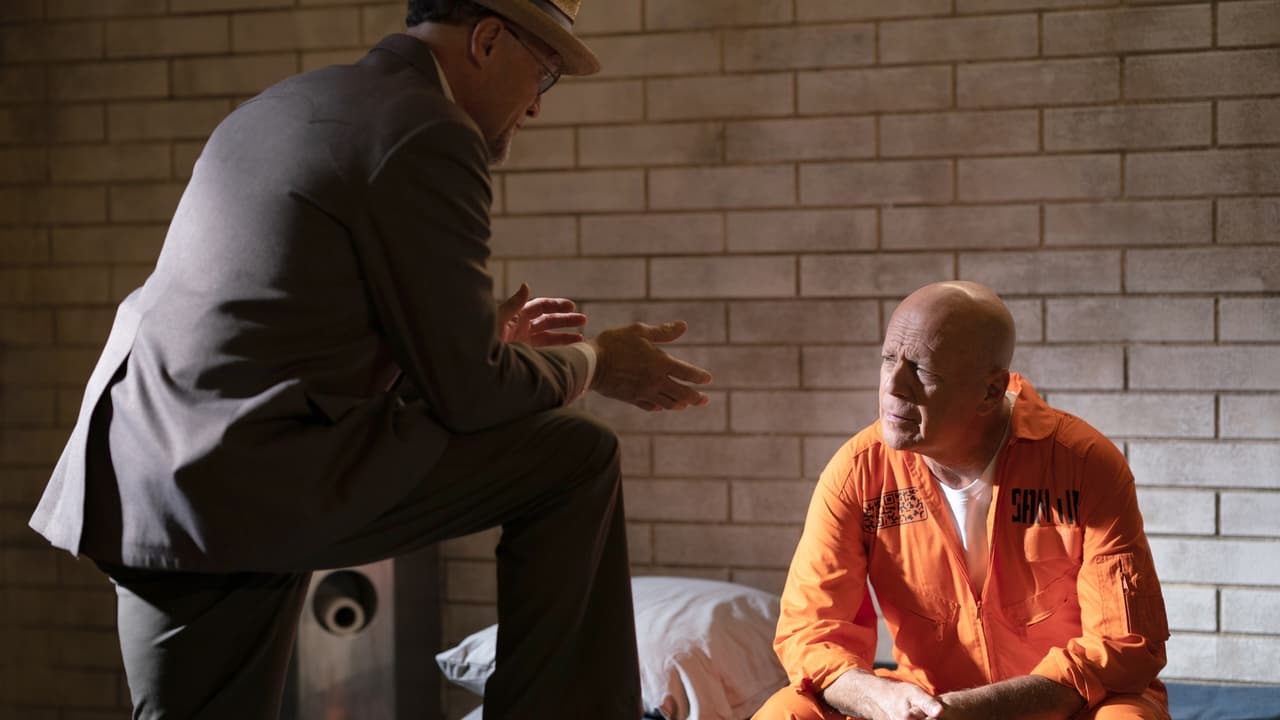
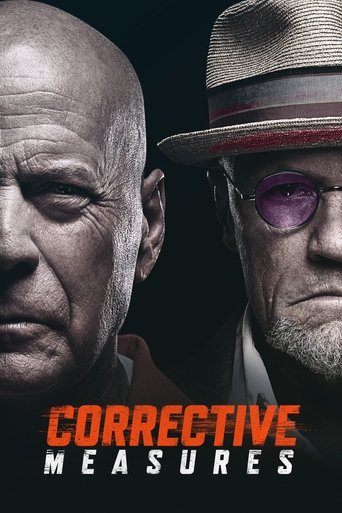
I know I shouldn’t expect anything other than bitter, unwitting irony of a movie wherein Bruce Willis plays a character named after and apparently inspired by Freakazoid supervillain The Lobe — Julius Loeb, aka "The Lobe," is said to have a "super brain," an instance of retroactive tastelessness —, but Corrective Measures actually strives to perform below expectations.
The plot, such as it is, takes place in a prison for super-powered criminals. The prison is called "San Tiburon," which translates to "Saint Shark." I’m bummed that, in a movie so top-heavy with exposition, they never find the time to explain when and how a fish was canonized.
San Tib, as it is known, holds a bunch of Suicide Squad rejects including but not limited to The Conductor (Tom Cavanagh), Payback (Dan Payne), and Diego Díaz. The first two are thinly-veiled parodies of Electro and The Punisher. The third is a Jean Grey wannabe with an Aerith and Bob name. And we also have a Meaningful Name (Loeb=Lobe). This stuff is not all that terrible; in fact, it’s how you have fun with names — not randomly, like "San Tiburon," but with a specific target in mind, even if it’s an obvious one.
My problem is that the movie doesn’t go full farce, so that when something really stupid happens, it sticks out like a sore thumb, especially when nobody but the audience seems to notice it.
Consider the «Nullies,» a term used to refer to both something «in the lights, the water, food [the inmates] eat» and an ankle bracelet; as the name implies, Nullies nullify the supervillains’ superpowers.
This is all well and good, except that the whole concept of Nullies appears to be based on the honor system; that is, it works as long as the inmates agree to uphold it — this, of course, raises the question, why do the inmates uphold it?
None of this is ever made explicit, but what other possible conclusion can we arrive at in light of certain events? Events such as The Conductor cracks open his ankle Nullie with a modified fork (i.e., one with all but one tine broken off). I mean, a f---ing fork! Never mind that I don’t think you get metal cutlery in jail, it’s still a f---ing fork.
Later on it’s supposed to be a big surprise that whatever the stuff is in the "lights, water, and food" accomplishes nothing (The Lobe: "I haven't eaten that prison shit since my parole." Huh? What do you mean, "parole"? What the hell are you still doing in prison, then?), but the Overseer (Michael Rooker) should have known, regardless of whether or not he truly is "an idiot," that something was up the moment The Conductor was able to use his powers sans difficulty.
All things considered, it doesn’t take a "super brain" to know that even parody needs some sort of structure — a method to the madness, so to speak; after all, can’t break the rules if there aren’t any to break in the first place.