
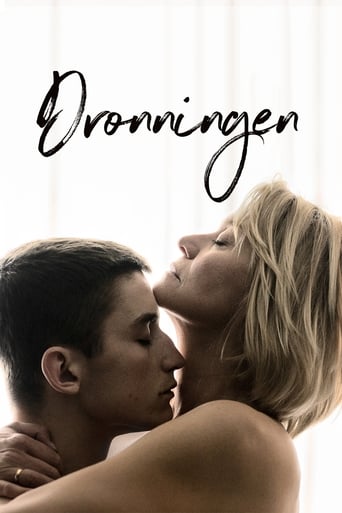
罪と女王
あらすじ
No synopsis available.
作品考察・見どころ
興行成績
製作費: $19,000,000 (29億円)
※製作費・興行収入はTMDBのデータを参照しています。収支は(興行収入 - 製作費)で算出したFindKey独自の推定値であり、広告宣伝費や諸経費は含まれません (1ドル=150円換算)。
No synopsis available.
製作費: $19,000,000 (29億円)
※製作費・興行収入はTMDBのデータを参照しています。収支は(興行収入 - 製作費)で算出したFindKey独自の推定値であり、広告宣伝費や諸経費は含まれません (1ドル=150円換算)。
監督: May el-Toukhy
脚本: Maren Louise Käehne / May el-Toukhy
音楽: Jon Ekstrand
制作: Caroline Blanco / Rene Ezra
撮影監督: Jasper Spanning
制作会社: DR / SVT / Nordisk Film Denmark
**_An exceptional, albeit painful, film that reminds us men aren't the only ones capable of sexual abuse_** >_Thou art my son, I am thy father's wife,_ >_I ache toward thee with a bridal blood,_ >_The pulse is heavy in all my married veins,_ >_My whole face beats, I will feed full of thee,_ >_My body is empty of ease, I will be fed,_ >_I am burnt to the bone with love, thou shalt not go,_ >_I am heartsick, and mine eyelids prick mine eyes,_ >_Thou shalt not sleep nor eat nor say a word_ >_Till thou hast slain me. I am not good to live._ - Algernon Charles Swinburne; "Phædra" (1866) I was lucky enough to get tickets for the _Dronningen_ [_Queen of Hearts_] screening at DIFF, where the film was introduced by lead actress Trine Dyrholm. When she returned for a post-screening interview and to receive the 2020 Volta Award, she apologised that she'd been enjoying a nice dinner whilst we'd been watching the movie. And an apology was welcome, not because _Dronningen_ is a bad film, but because it's an exceptionally difficult film – like Adrian Lyne at his most sensationalist, but with all the commercialism stripped out and the morality kept fuzzy. Examining the destructive power of forbidden desire and how sexual abuse can masquerade as consensual seduction, it's a film wherein our protagonist becomes our antagonist, where her initial self-confidence transforms into heartless manipulation, where our emotional centre shifts multiple times, where our own morality is examined, where our sympathies are used against us as we're pushed to condone something abhorrent. A psychologically fascinating and morally complex film, in the age of #MeToo, _Dronningen_ dares to remind us that women can be the perpetrators of abuse just as men can be its victims. Anne (Dyrholm) and her husband Peter (Magnus Krepper) are an affluent middle-class couple living with their two young daughters on the edge of a forest just outside Copenhagen. Anne is a partner at a law firm and specialises in defending victims of sexual assault and domestic violence, whilst Peter is a top surgeon. Their life is uneventful but happy, and although their jobs mean they don't see a lot of one another, they both seem content. Things change, however, when Gustav (Gustav Lindh), Peter's recalcitrant teenage son from his first marriage, arrives to stay with them, having been expelled from his Swedish school. His mother is having problems keeping him on the straight and narrow and hopes that time spent with Peter will set him right. Although initially, Anne is far from enthused about his sullen presence, when she acquires some unexpected leverage, she uses it to force him to improve his behaviour. This creates something of a bond between the two, and as time passes, he awakens something in her, and she seduces him, with the duo subsequently embarking on a dangerous affair which could potentially destroy all three of them. Written by May el-Toukhy and Maren Louise Käehne and directed by el-Toukhy, _Dronningen_ initially walks a very well-trodden genre path – an unexpected attraction turns to rampant lust and becomes as destructive as it is passionate. We've been here many, many times before – films such as Lyne's _Fatal Attraction_ (1987) and _Unfaithful_ (2002), Alan Shapiro's _The Crush_ (1993), and Andrew Davis's _A Perfect Murder_ (1998), as well as literature such as Ford Madox Ford's _The Good Soldier_ (1915) and Vladimir Nabokov's _Lolita_ (1955). What's so brilliant about _Dronningen_, however, is the direction taken not only by the story, but by Anne herself. El-Toukhy uses the genre template as nothing more than a frame onto which to graft her real concerns. For example, she initially depicts Anne and Gustav's relationship in generic terms as a story of sexual (re)awakening, before abandoning genre beats and revealing a story of abuse camouflaged as a consensual affair. Much of the film's strength lies in how the audience is initially encouraged to empathise with Anne before having the rug pulled out from under us and our own morality called into question – how could we ever have identified with this woman? It's easy enough when you consider that she's the emotional centre of the film for the first two acts, she's also the narrative focaliser, and she's introduced as brave, driven, and confident, someone who's appalled not only at the abuse her clients have suffered, but so too at a system which could potentially find them to be in the wrong (after she loses one particular case, she abandons decorum and legality, and approaches the perpetrator in a parking lot to tell him exactly what she thinks of him). Once the affair begins, although the audience is shocked at what Anne is doing, el-Toukhy depicts things in such a way that we revel in the sense of erotic freedom, savouring Anne's sexual awakening almost as much as she does herself (the first time we see her smile in the film is during a scene where Gustav coaxes her to join him and her daughters in a lake). It's not until she's faced with the possibility of the affair being revealed that we see who Anne truly is – a heartless and cruel exploiter, incapable of seeing her own immorality even as she lectures others for their behaviour, incapable of seeing that she is perpetrating a similar kind of abuse as that suffered by her clients. That we initially identified with such a woman speaks volumes about el-Toukhy's mastery of tone. Another important element is the gender paradigm. As mentioned, we're initially encouraged to empathise with Anne and approve of what she's doing. After all, she's a hardworking, decent woman whose marriage has lost its spark, so who could deny her a little bit of illicit fun? But would we think the same were the genders reversed – how would we react to the story of a fortysomething man seducing a 19-year-old girl? With this in mind, el-Toukhy interrogates our morality, by 'tricking' us into condoning Anne's actions and later asking how we could ever have done so – gender, she suggests, is irrelevant in cases of abuse, and the fact that we give a woman a pass to behave in this manner when we would crucify a man for doing the same thing is part of the film's complex thematic texture. In terms of acting, this is some of Dyrholm's best work (which is saying a lot considering her extraordinary CV). Initially playing Anne as strong-willed and inherently decent, Dyrholm does drop a few hints that all is not as it appears, that there's something darker and more selfish underneath – she point blank refuses, for example, to apologise for something she knows she shouldn't have done, with her partner at the law firm lamenting, "_can't you just admit you were wrong for once_". As it turns out, no she can't. Once Gustav arrives on the scene, Dyrholm loosens up, carrying herself differently, and displaying a different kind of confidence than we've seen thus far – a more personalised confidence, one that has to do with her sense of self rather than her professionalism. Later, when she faces the possibility that Peter could learn of the affair and that her comfortable middle-class life could be jeopardised, she shuts herself down, becoming almost eerily void of emotion and interiority. That she has very much transitioned from protagonist to antagonist is made apparent in two especially chilling scenes – one involving herself, Peter, and Gustav, and another involving just herself and Gustav. The Anne in these scenes is a million miles away from the Anne who threw caution to the wind, giddily enjoying sex in the forest with her stepson. Throughout it all, Dyrholm never lets us forget that Anne is very much a flawed human, but so too does she wholly commit to playing Anne's darker qualities; when the wheel turns, Dyrholm makes sure that we come to despise Anne. It's a performance of great dimensionality, and with its copious nudity and one hard-core oral sex scene, it's the kind that critics would once have called "brave". I just call it exceptional. Working opposite such a powerhouse performer can't have been easy for the 25-year-old Lindh, who's only been acting professionally since 2015, but he holds his own admirably. And much as Dyrholm creates a fascinating arc for Anne, so too with Lindh, who plays Gustav with an exceptional visceral quality, his emotions always on the surface – from sullen teenager who barely says anything to laidback houseguest enjoying his surroundings to confident young man thoroughly enjoying a sexual relationship with an older experienced woman to bitter child unsure how to deal with what is happening to complete emotional wreck. His arc is essentially the inverse of Anne's – whereas she's introduced as the protagonist, someone with whom we're encouraged to identify, yet she later becomes nothing short of a monster, he's introduced as an unlikable, resentful, petulant, and moody brat, yet he evolves to the point where he becomes the emotional fulcrum of the final act, with Lindh's heart-breaking performance in one particular scene as strong as anything you'll see all year. As Peter, Krepper has a lot less to do than his co-stars, but he does it well, never putting a foot wrong. He plays Peter as decent and loving, but not especially warm or attentive. Sex between him and Anne is a rarity, and even when they do have sex, it's vanilla and rote. However, these are his most significant crimes; he's a good husband and father and a kind man, and Krepper plays him as unable to even conceive that Anne could have seduced his son because it's simply so far outside his understanding of the world. If Anne and Gustav represent the emotional centre of the film at different points, Peter is the moral centre throughout. Looking at issues of gender inequality in relation to sexual trauma and abuse, _Dronningen_ is a story of how a woman can be a predator just as easily as a man. Indeed, the film reminds us that gender is irrelevant when considering the pain caused by such predation. Ultimately, Gustav is no different from the clients who Anne represents, but whereas she is shown to be remarkably protective of them (even allowing one to stay in the house the night before she's due to testify), when Anne finds herself in the role of the perpetrator, her treatment of Gustav is as reprehensible as anything done to her female clients by their male abusers. This is tricky and emotionally complex territory, and _Dronningen_ is never anything less than thematically fascinating. It's by no means an easy watch, but it is an exceptional piece of filmmaking.