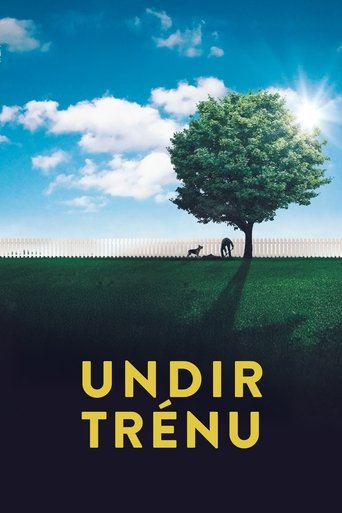
Undir trénu
あらすじ
No synopsis available.
予告・トレイラー
興行成績
製作費: $2,054,738 (3億円)
※製作費・興行収入はTMDBのデータを参照しています。収支は(興行収入 - 製作費)で算出したFindKey独自の推定値であり、広告宣伝費や諸経費は含まれません (1ドル=150円換算)。
No synopsis available.
製作費: $2,054,738 (3億円)
※製作費・興行収入はTMDBのデータを参照しています。収支は(興行収入 - 製作費)で算出したFindKey独自の推定値であり、広告宣伝費や諸経費は含まれません (1ドル=150円換算)。
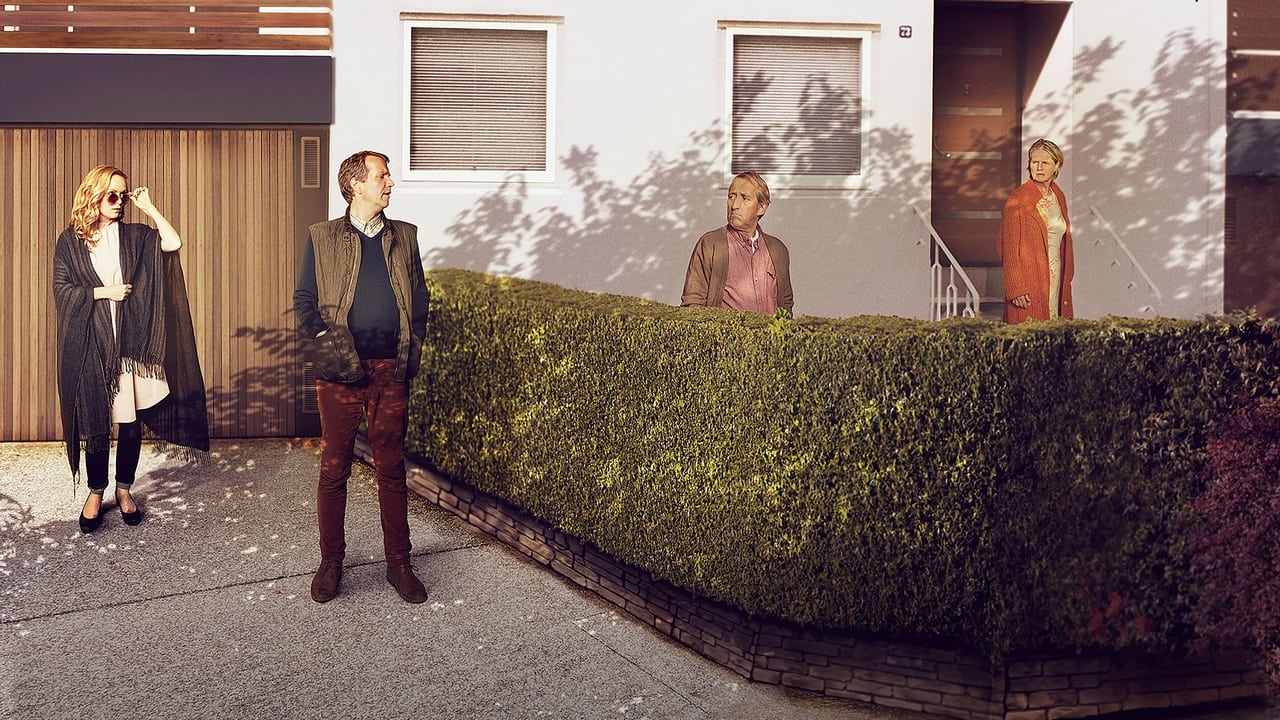
**_Decent but forgettable_** > _There are some terrible things in the air these days and I think we've reached the point where it's seriously threatening our existence on this planet. If we look at the biggest narrative of our times, climate change, it's exactly about that. The whole world has to come together and let go of a certain way of living but it seems that we just can't. We all have the same objective, and really we all have to compromise in one way or another and be considerate of each other - and if we don't, we are risking the future of our children. But still we can't do it. Ho__w fucked up is that? It's this terrible individualistic way of thinking and living which is indeed encouraged by our capitalistic society._ > _What happened during the development of this script is that I tried to open up the narrative, making it receptive to different interpretations of those ideas. By the end it turns into sort of a fable where the larger metaphor is living in a community, in peace with other humans. In that sense you can also read this story as one about two different, conflicting nations, ethnic or religious groups - I think those stories share some things in common with the issues we can have with our neighbours._ - Hafsteinn Gunnar Sigurðsson; "_Undir trénu_ Production Notes" Anyone who knows anything about Scandinavian cinema knows two things. The first is that Nordic noir is huge at the moment. Originally used to describe crime fiction told from the perspective of the police (good examples are Maj Sjöwall and Per Wahlöö's Martin Beck novels, Henning Mankell's Kurt Wallander novels, and Jo Nesbø's Harry Hole novels), the term has more recently been employed in relation to a wider-ranging genre of television shows (_Forbrydelsen_, _Bron/Broen_, _Ófærð_, _Fortitude_, _Midnattssol_) and films (Erik Skjoldbjærg's _Insomnia_, Balthasar Kormákur's _Mýrin_, Christian E. Christiansen's _ID:A_, Thomas Vinterberg's _Jagten_). The other thing that anyone knows is that Nordic comedy is jet black, with its opacity often such that non-Nordic audiences can be left asking "was that really a comedy?" Not necessarily because they didn't find it funny, but because they're not entirely sure what parts they were supposed to find funny, _how_ they were supposed to find it funny, even _if_ they were supposed to find it funny. I'm thinking of films such as Jalmari Helander's _Rare Exports_ (a research team in Lapland find a massive underground chamber, in which is held a hibernating Joulupukki, the murderous Scandinavian precursor of Santa Claus), André Øvredal's _Trolljegeren_ (found-footage of a trollhunter, who operates by weakening his quarry with the sounds of Christian rock), Timo Vuorensola's _Iron Sky_ (Nazis living on the moon since 1945 return to earth to re-establish the Third Reich), Felix Herngren's _Hundraåringen som klev ut genom fönstret och försvann_ (the 100-year-old resident of a nursing home escapes from a window and has a series of adventures), Hans Peter Moland's _Kraftidioten_ (a snowplough driver starts a gang war whilst seeking vengeance for the death of his son), Grímur Hákonarson's _Hrútar_ (two brothers who haven't spoken in decades must work together to save a herd of sheep), and Anders Thomas Jensen's _Mænd og høns_ (a group of five middle-aged half-brothers learn of one another's existence for the first-time). In Iceland, the term used to describe this kind of comedy is "_gálgahúmor_" ("gallows humour"), and it's a style which is often lost on international audiences – as the brief plot summaries above suggest, it often focuses on dark subjects which one wouldn't immediately recognise as comedic - what we might term, only partially correctly, as "tragi-comedy". And so, with all of this in mind, we have _Undir trénu_ [_Under the Tree_], as textbook an example of _gálgahúmor_ as you're likely to find. Written by Hafsteinn Gunnar Sigurðsson and Huldar Breiðfjörð, and directed by Sigurðsson, the film begins with Agnes (Lára Jóhanna Jónsdóttir) accusing her husband, Atli (Steinþór Hróar Steinþórsson), of cheating. Although he denies it, she throws him out, and he returns to his parents, Baldvin (Sigurður Sigurjónsson) and Inga (Edda Björgvinsdóttir). A shadow hangs over the family in the shape of the disappearance years earlier of Atli's older brother, Uggi. Whilst most people, including Atli and Baldvin, believe Uggi committed suicide, Inga refuses to accept this, still expecting him to return home at some point. Next-door live Konrad (Þorsteinn Bachmann) and his wife Eybjorg (Selma Björnsdóttir), who is closer in age to Atli than she is to Konrad himself. The two couples are in the midst of a passive-aggressive dispute concerning a large tree in Baldvin and Inga's garden, which is casting a shadow over Konrad and Eybjorg's sundeck. Baldvin is open to the possibility of trimming it, but Inga point-blank refuses, arguing that Konrad's first wife never had a problem with it, and it is only because of Eybjorg's vanity that there is an issue now. All of this is set up within the first ten minutes or so, and what plays out for the rest of the film is a juxtaposition of the two main conflicts – that between Agnes and Atli on the one hand, and that between the neighbouring couples on the other – as each becomes more and more bitter, and the parties involved more extreme. And this is essentially the film's bread-and-butter – a serious marital conflict contrasted with a farcical neighbouring conflict, with each commenting upon and informing the other; no matter how serious the dispute regarding the tree becomes, it is always tempered and rendered preposterous by the much more consequential issues playing out between Atli and Agnes. Likewise, no matter how acrimonious that conflict becomes, it is always called into relief by the comedic elements in the dispute concerning the tree. This is how a lot of _gálgahúmor_ works – the serious and the absurd placed alongside one another so as to create a somewhat unrealistic _milieu_. An especially good example of this in _Undir trénu_ can be found in the opening scene, which plays out in a more conventional comedic style than is typical of the genre, before a tonal shift renders everything far less humourless. The film begins with Agnes and Atli going to bed, as Agnes puts in ear-plugs, and the sounds of a couple having sex can be heard on the soundtrack. The film then cuts to a shot of a couple in bed, with the sound bridging the cut, and letting the audience know this is the same couple heard in the previous scene. Except it isn't. Another cut reveals that some time has passed, and the couple in bed is actually a film Atli is watching on a laptop in the living room. Wearing headphones, he doesn't hear Agnes come in, and as he begins to masturbate, she asks him if he's watching porn. Slamming the laptop shut, he jumps up and flat out denies it. However, he is unaware that the porn he was watching is now playing on the computer screen behind him, in full view of Agnes. All pretty funny up to this point. However, the farcical manner in which the scene has progressed thus far is undermined as Agnes realises he hasn't been watching professional porn – rather, he has been watching an amateur video, in which he is the star. The multiple misunderstandings and layered realisations, coupled with a well-handled manipulation of audience expectation (and an excellent example of an L cut being used thematically) render the scene farcical, but only up until the point Agnes recognises Atli on screen. Here, the tone shifts dramatically as the film essentially switches genres mid-scene. Another example of such a shift is found during a resident's meeting in Agnes and Atli's apartment block. The meeting has been called by an especially fastidious resident to address the loud love-making of a young couple – the same couple heard in the opening scene. As the irritated chair and his heavily pregnant wife detail all they've had to listen to at night, including a truly hilarious reaction to the young couple's dirty talk, the scene plays out in a fairly conventionally comedic way (the addition of a hard-of-hearing neighbour who doesn't understand what all the fuss is about is particularly funny). This comedic element is maintained when Agnes attempts to embarrass Atli by standing up and asking the residents if they think it's normal that he films himself having sex with women and then masturbates to the footage, to which the man in the loud couple nonchalantly responds, "_Sure_." However, the scene darkens considerably when nobody reacts to Agnes's question the way she expected, and she is effectively dismissed and told to sit back down, leaving herself far more embarrassed than anyone else. Comedy in the midst of heartbreak, tragedy transposed into humour. The film also features elements which are much more straightforwardly funny, albeit if relying on the audience's capacity to detect irony. For example, as Agnes and Atli's split becomes more and more bitter, Baldvin chastises Atli, telling him that he and Agnes should have been able to sort things out by now, talking things through "_like grown-ups_". Good advice. Except, when Baldvin offers it, he is about to spend the night sleeping in a tent in his back garden so as to prevent Konrad (who had purchased a chainsaw earlier in the day) from cutting down the tree. Atli himself doesn't point this irony out to Baldvin, and it's up to the audience to read between the lines and see the absurdity on display. Unfortunately, however, for a film with such a farcical plot, it's immensely predictable. About twenty minutes in, I guessed how it would end – not just in terms of where the plot would go, but I literally guessed what the last shot would be. And I was right. A colleague of mine came to an identical conclusion when he was watching it. That kind of predictability is never good. It's also a little difficult to see what Sigurðsson is trying to say with the film. Part absurdist comedy-of-manners, part satire of first-world problems, there isn't a huge amount of substance here. Is the film offering up a commentary on the inherent pettiness that can come to dominate divorce proceedings, or is it more concerned with mocking the self-importance of middle-class suburbia and the attitude that an argument about a tree can be seen as more important than the breakup of a marriage? Also, when the inevitable happens, and the humour gives way to inexorable darkness, with the two conflicts dovetailing, and tragedy enveloping all six main characters, I don't think Sigurðsson handles the transition especially well. Rather than allowing the material to become as ultra and unironically serious as he does, perhaps maintaining a comedic through-line would have been more effective (_Kraftidioten_ is a good example of how to do this – although the film gets exceptionally dark in the final act, which features precious little seemingly worth laughing at, it maintains its comedic edge, right up until, literally, the last shot). _Undir trénu_ lets the comedy drop away entirely, and although the last scene may be an attempt to share a wink with the audience, it comes on the back of a couple of scenes which weren't especially well integrated into the tone of the preceding narrative. All in all, it's enjoyable enough whilst it lasts, but there isn't a huge amount of substance, and, in the long-term, it's not especially memorable.