**The art of cooking while living among different seasons.**
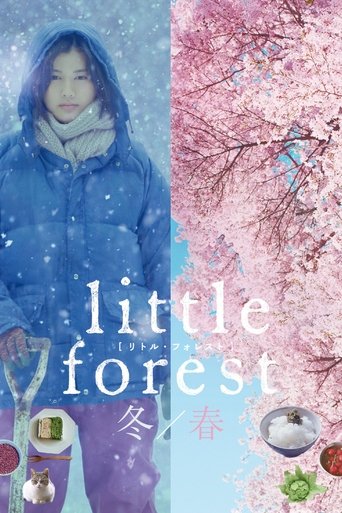
The second part of the manga based film, 'Little Forest'. One of the best duologies and one of the best food films I've ever seen. Literally, it was a four part film series with the seasonal topics like summer, autumn, winter and spring, but you would see it is like two episodes from each film which opens with the same intro. Which briefs about the place where it set in, and then go straight to its business.
Basically, you can call this a mini-series, that's how in the west they call such film concepts. There's already a Korean version is in the making, due in the mid 2018. It was simply outstanding as the previous one. And one should watch them both continuously as the opening statement says for your better understanding.
Winter, what do you think the farmers would do in this season. I really don't know. I haven't come from such place. All I think is skiing, building a snowman or slippery roads. That's why this film impressed me. Something letting us know what we never knew. Ichiko had her own plan. I guess most of her counterparts in the Japan would do the similar task to counter the harsh weather. That the art of preserving the fruits and vegetables, as well as making the seasonal dishes using them.
Not everything is just the indoor activities, but utilising the outdoor gifts like the snows to preserve the precious ingredients and growing vegetations are admirable. Cultural significance, like gathering and sharing their produce/harvest, totally give another glimpse of how the Japanese do. On that aspect, this film quite stays away from Ichiko in a few sections. The other characters take over for a brief. That remains a bit mystery. The film never went deep digging her personal life, particularly what happened between her and her mother. So it never cared to say further as the narration proceeded towards the end.
> ❝I'm pretty lenient when it comes to cabbage white butterflies. But I show no mercy to caterpillars.❞
Spring, you can call the season for rebirth of all plantation. The white visuals would be replaced by the green everywhere. Not just the plants, but also the zoological lives like butterflied et al thriving. There's one problem with that despite they are considered beautiful, those are pest according to the farmers. Ichiko reveals her own experience with her mother when she was a kid. But when it comes to her in the same position as her mother, what is her counter measure can be observed.
As for the food theme, it was a complete satisfactory film. But the story, the personal life of Ichiko was not explained well. I believe the original source could be well detailed, particularly about her mother. I always wondered about her mother, being an average mother, but an excellent cook who really inspired Inchiko to follow the same path. Remembering from her childhood and trying to recreate the same dish with the taste, in some cases, experimenting with the new ingredients, once again you will be mouthwatering.
I loved both the film, and I wished for another installment. Gosh, why do it has to be only two films. It was a great direction. It was beautifully written for the screen and the locations, mind blowing. All the four seasons very pleasing to see on the screen. From the hot summer to autumn, cold winter and the spring. One year cycle of the seasons, as well as how the humans adapted to cope with the changes in the nature was well picturised. Beside the sub-topics, other than the film's notion were nicely placed in the parts of the narrative.
I've said almost everything about the film(s) in the previous review. Because I did not expect anything different in this part. Just the same flow, but different season and dishes. Also the farming, according the seasons was the highlight of the film. The performance was great, though, as I said it all looked like a documentary film of the real lifestyle in the countryside.
I haven't seen many documentaries about the Japan, so that's one the reasons why I overjoyed it. I know a couple of people who love cooking and they are indeed good at it, despite that's not their profession. I'm thinking to gift them this Blu-ray. You might have seen many food flicks, but this is different and a must see. So don't miss it!
_9/10_