In the 1960s, the director Michaelangelo Antonioni left his native Italy for a series of a films abroad. BLOW-UP, shot in 1966, captured Swinging London at the dawn of the Sixties counterculture when radical new fashion and music served as the nexus of youth innovation. But as Antonioni moved to the United States and began shooting ZABRISKIE POINT, ultimately released in February 1970, he now captured a counterculture that was tougher and politically radical, with Black liberation movements and university students advocating in-your-face or downright violent methods for effecting social change.
In southern California, a young man named Mark (Mark Frechette) flees a university sit-in after shooting at one of the riot police besieging it. A young lady named Daria (Daria Halprin), who works as a secretary for a large real estate developer building out in the desert, is driving to Phoenix for a meeting. They cross paths when Mark, who proves to have some training as a pilot, steals a light plane from an airfield for a little joyride. He buzzes her car for laughs. When he finally lands, Daria quickly overcomes her fear at this aerial taunting and falls for him. They spent an afternoon together in the desert, at the eponymous point in Death Valley. Yet while these two young people in love enjoy this brief splendour far away from it all, they must eventually return to civilization, and then things come to a head.
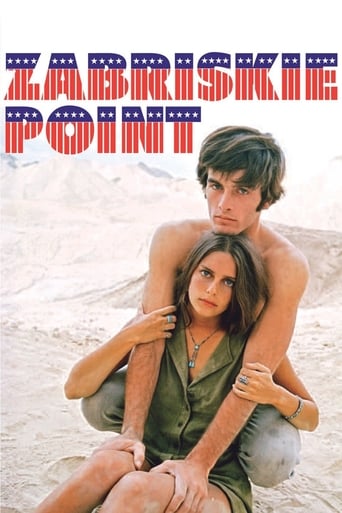
ZABRISKIE POINT was a critical failure when it was first released, and I was expecting to dislike it. However, the film's flaws are few and, among everything else the film offers, forgivable. One of those flaws is the acting during the relatively brief portion when the two leads meet. Frechette and Halprin are extremely photogenic and fashionable -- it's hard to believe they weren't established Hollywood bombshells, but rather amateurs and they had actual counterculture credentials. However, as much as they provide the film visually in moments they appear alone, during their brief time together they have zero chemistry and the dialogue they exchange is delivered clunkily.
The other flaw is the characterization of Mark: by the end of the film, Daria has seen things that stir her to anger and lead her to question the conventional society in which she works. However, the script (a collaboration between Antonioni, longtime collaborator Tonino Guerra, and Sam Shepherd) never explains why Mark is so bent on destruction. The audience just feels that he's a delinquent with emotional problems, and that makes it difficult to sympathize with him.
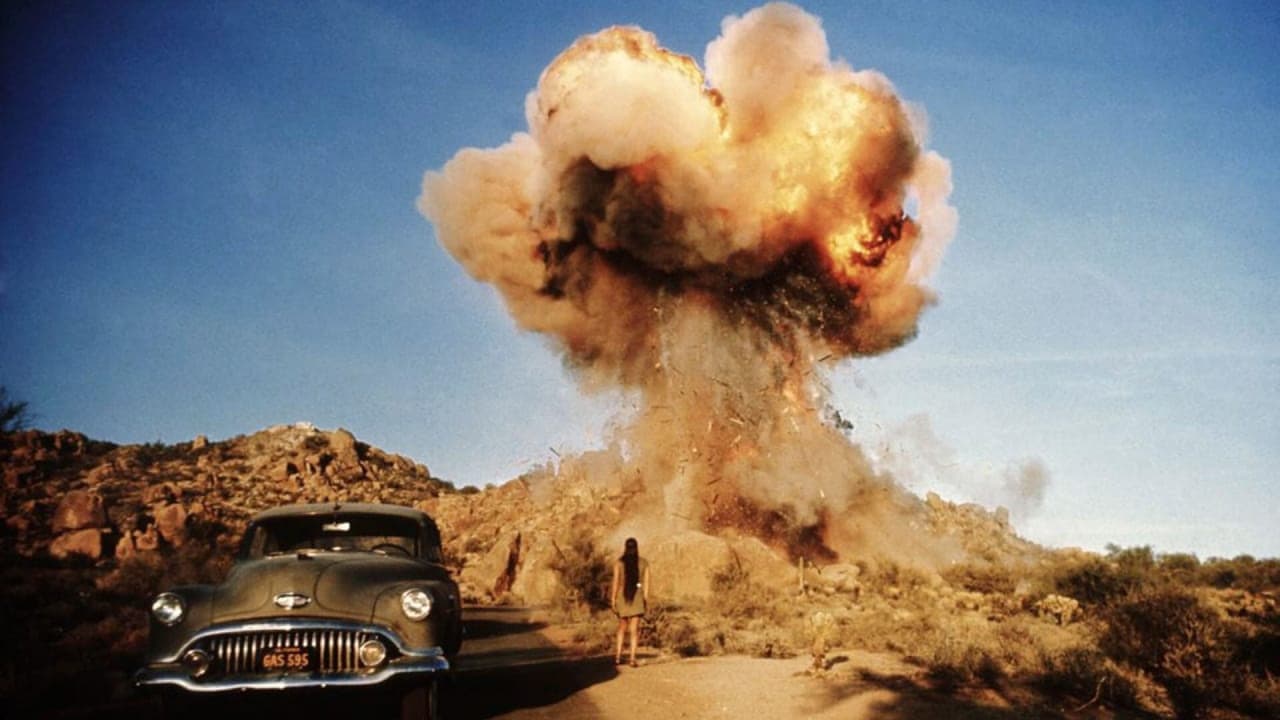
Yet in spite of those weaknesses, this is not at all an unenjoyable film. Forget the stupid interaction of Mark and Daria. Instead, just soak in Antonioni's visual poetry as captured by cinematographer Alfio Contini. The Italians must have been delighted by what they found far away from their native land. California of this era is revealed in all its peculiar grandeur, both the urban sprawl of Los Angeles (already utterly hostile to pedestrians) and the unforgiving but strangely beautiful desert. Most of Antonioni's trademark mise-en-scene from the Italian films is preserved here in this foreign location. Unexpected, however, is the savage ending -- sometimes dubbed "the violent scene" -- where the film makes its strongest blow against complacent bourgeois culture. One wonders if Antonioni had seen Jean-Luc Godard's 2 OU 3 CHOSES QUE JE SAIS D'ELLE, with its capstone unveiling of consumer products, and thought "I can one-up that." The result is a feast for the eyes.
It's curious too how the passage of time can endow a film with poignant resonances beyond what the filmmaker could have intended. Antonioni shot this film in 1968-69 when the counterculture was a brave new world, but audiences today will see it as a vivid document of a past now half a century gone, and the thought that all this colour, idealism, fashion and design is long dead smarts.
Antonioni's loose trilogy consisting of L'AVVENTURA, LA NOTTE and L'ECCLISE might be the best introduction to this filmmaker, but I am glad I have explored his other work, and while ZABRISKIE POINT is notably flawed compared to its predecessors, it has haunted my thoughts in the weeks after I screened it, and that says a lot to its credit.