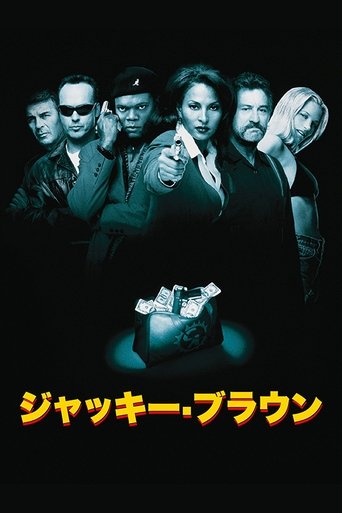
Jackie Brown (1997)
Directed by Quentin Tarantino
Quentin Tarantino could have spent his career chasing the adrenaline rush of Reservoir Dogs and Pulp Fiction, refining his trademark violence and verbal pyrotechnics into a formula. Instead, he made Jackie Brown, and in doing so, announced that he was capable of something rarer: restraint, maturity, genuine emotional complexity. This is still pulp fiction, still genre through and through, but it's pulp that trusts intelligence over spectacle, character over chaos. It's a film about middle-aged people running cons and running out of time, and it remains one of the finest sting movies ever made.
The comparison to The Sting (1973) isn't casual. Both films understand that the pleasure of a con isn't just in the reveal but in watching smart people think their way through impossible situations, manipulating information and perception until everyone sees exactly what the con artist wants them to see. Jackie Brown, a flight attendant smuggling money for arms dealer Ordell Robbie (Samuel L. Jackson), gets caught by the Feds and finds herself squeezed between the ATF and a criminal who kills loose ends. Her solution is to play all sides against each other, orchestrating an elaborate scheme where everyone thinks they're using her and no one realizes she's the one in control.
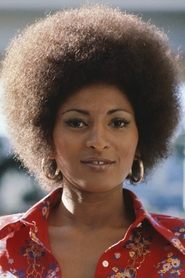
Pam Grier's performance is phenomenal, not because she's flashy but because she disappears into the role so completely that we forget we're watching an actress. One of my acting teachers used to say, "If it's a lie in the script you sure as hell better lie on stage!" Grier lies with absolute conviction. Jackie lies to the Feds, lies to Ordell, lies to bail bondsman Max Cherry, and Grier sells every deception with the weariness of someone who's been lying to survive her entire life. There's no winking at the camera, no signaling to the audience when she's being genuine versus when she's performing. We have to read her the way the other characters do, piecing together her actual intentions from fragments and inconsistencies, never quite certain until the end whether anyone, including Max, really knows her.
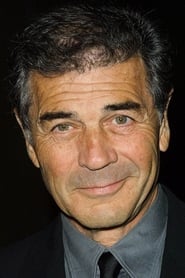
Robert Forster was her perfect partner, playing Max with a quiet decency that could have been boring in lesser hands but becomes deeply affecting. The genuine affection between them is totally believable; two people past their prime, past illusions, finding something like tenderness in the wreckage of compromise and disappointment. Their relationship isn't a subplot, it's the emotional heart of the film, the thing that makes all the intricate plotting matter. When Max helps Jackie, it's one of the most romantic gestures in Tarantino's entire filmography.
Samuel L. Jackson, of course, is great, playing Ordell with charismatic menace, all smooth talk covering a hair-trigger violence. This is Tarantino proving he could do way more than riff. It may be his most enjoyable and the one that can be watched again and again, like The Sting.