Review by the German Federal Film and Media Assessment Board (FBW)
Rating: Certified "Highly Commended" (Prädikat Wertvoll)
Starting from a frigidly futuristic business setting, an appropriately detached editor gives the chronically underpaid author Claudia the assignment to write five volumes of her sci-fi pulp novels within 36 hours, despite having only has three data ports at her disposal. Thus begins a trip that transcends any everyday experience, leading from her one-room sanctuary out into diverse worlds—where the question soon arises as to how real or virtual these realms are within the context of the film’s story. Perhaps, as the jury suggests, she is telling her journey more as a fragmented nightmare world.
Along the way, Claudia discusses various metaphysical issues. Both with her ex-boyfriend and with other characters from her narrative worlds. These characters are at times hostile, at times supportive. A noticeable constant is that technology and digitalization have taken over all areas of life throughout the entire 'multiverse,' even during the intake of food. Thus, Claudia also appears as a partial android; at the very least, her three ports enable a superhuman intake and processing of information. Significantly, the meaning of money is the only subject from today’s world that has survived.
At first, one does not look for a narrative thread and is fascinated by a cyber-technologized post-world in which human identity and what it means to be human are called into question. This is also due to the convincing, trashy settings, which always convey something simultaneously familiar and dismissively futuristic, still bearing witness to an affinity for life that has actually long since retreated from the post-world. Since we are guided through a kind of dream, these worlds seem less harsh.
The jury is reminded of Super 8 trash films from the 1950s and 60s or of Stanisław Lem, and even if—or precisely because—individual scenes sometimes feel like cheap theater, one clearly senses a distinct indie-film power and a concise, coherent cinematic language. Yet this 70-minute film, labeled as experimental (leaving the jury to ponder its best programming fit), ultimately offers a narrative that focuses on Claudia’s journey. The very structure of a journey makes the viewer want to know: What is her vision? What drives her, beyond simply completing the five volumes? Is it about saving humanity—or the multiverse—from the aforementioned virus, the "O-Cloud"? This common thread is difficult to decipher; the stations, characters, and conversations remain too perplexing. At times, this is exhausting for the jury, but it also reinforces the impression of being lost—not only Claudia, but beyond her. Her character and her search continuously radiate loss.
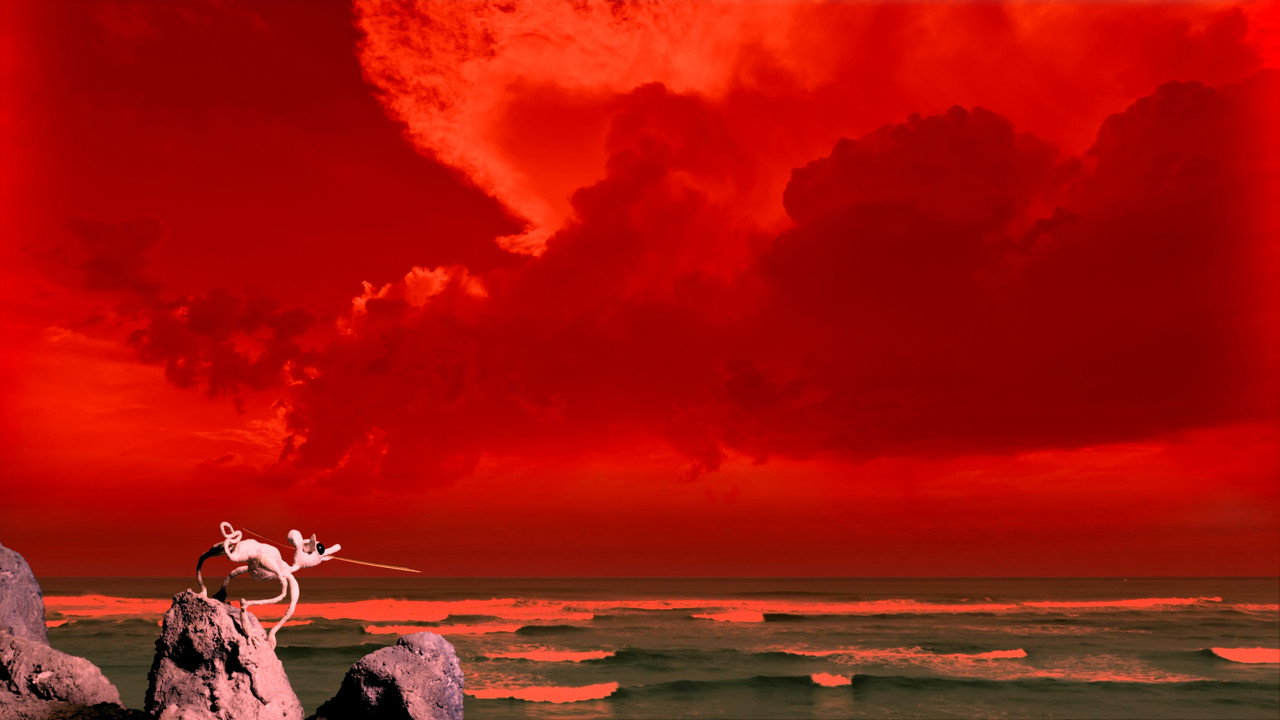
The ideas, some of them quite witty—such as the clever, talking mouse that seemingly escaped from her stories—along with the use of stop-motion and the often-interesting film locations, subtly complemented by futuristic VFX worlds, string together without aiming for a single meaningful or chronological reception. Director Valentin Hennig and Tom Whalen as writer reflect on the massive transformation of our society in a timeless way. Thus, this highly idiosyncratic search for traces of identity in a post-world that may no longer be salvageable can thoroughly captivate, even if a somewhat conflicted overall impression remains.
Weighing all arguments and following a very exciting discussion, the FBW jury is pleased to award the film the certificate HIGHLY COMMENDED (Prädikat WERTVOLL).