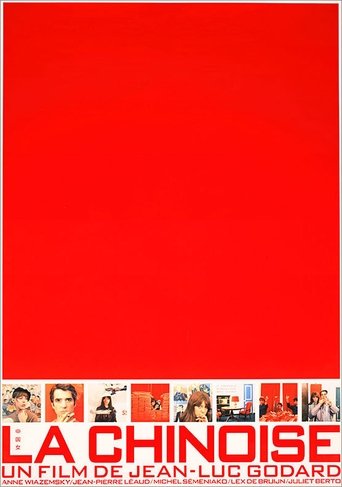
In 1966, Jean-Luc Godard made the acquaintance of some young members of the French Left who felt a strong pull towards Maoism. By looking to China, they sought to escape the traditional division of the French Left into supporters of the Soviet Union, which had lost its revolutionary fervour, and Trotskyist parties, which were impotent. (Of course, at the time the West was still generally unaware of the horrific toll of Mao's policies.) Godard, whose sociological curiosity and political engagement was strong in these years, decided to study this phenomenon, and the result is LA CHINOISE. While Godard would eventually go on to make a few films that were so didactically political that one felt bludgeoned by the message and watching was no fun, this one surprised me in how entertainingly its plot played out and how astute its observations were.
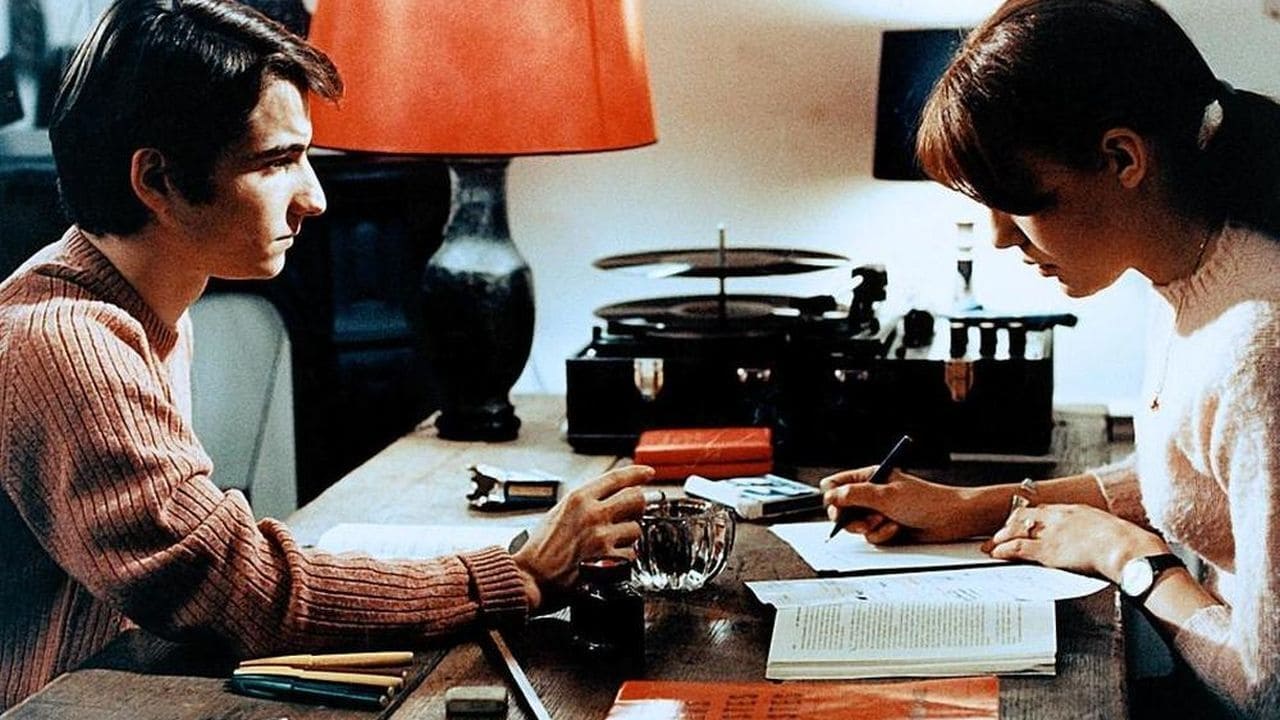
In a Parisian flat borrowed for the summer while one member's parents are away, a group of young radicals lodge together and fancy themselves a revolutionary cell. Chief among them are Guillaume (Jean-Pierre Léaud), Véronique (Anne Wiazemsky) and Yvonne (Juliet Berto). They read daily from Mao, decrying the Soviet Union and French society, and practicing their demagoguery for their occasional attempts to bring their message into the streets. Gradually, they come to decide that terrorism is necessary to achieve their goals, and they gang up on the sole dissenter from violence and kick him out of the flat. Francis Jeanson, a French academic and opponent of the war in Algeria, as well as Wiazemsky's actual thesis adviser, appears as himself in a scene where he attempts to dissuade Véronique from violence, asking just how much support from the oppressed masses does this sheltered girl think she has.
As desperate as he was for a cause to uphold, I don’t believe that Godard really committed himself deep down to Maoism or revolutionary socialism in general. His bitterness against the staid French status quo is palpable, and he likes how the French Maoists at least recognized a need for change, but LA CHINOISE affectionately criticizes its subjects more than it celebrates them. Rather than presenting Maoism convincingly as a way forward, LA CHINOISE ultimately suggests it was only the most recent expression of the drive to rebellion that appears afresh in every young generation. While these characters are Maoists, he borrowed the basic outlines of the plot from Dostoyevsky, who described a set of young radicals well before Marxism-Leninism. The filmmaker underscores how such idealistic young people take themselves too seriously, he shows their adoption of Maoist art as a sort of fashion statement, their use of Maoist terminology as the latest hip slang.
There are some fun touches here, the acerbic humour and amusing dialogue that Godard brought to his storytelling. The occasional use of Brechtian distancing techniques, like when Guillaume suddenly breaks character and talks to cinematographer Raoul Coutard, lead the viewer to reflect more on what is happening. And in spite of Godard's revolutionary sentiments, LA CHINOISE maintains a dialogue with the film tradition (cinephiles will chuckle at the avant-garde snippet that occasionally pops up in the soundtrack, a clear nod to Ingmar Bergman's film PERSONA).
Like Godard's early colour films, this is also a visual pleasure. Much of the first half of the film seems to me a study of faces: Léaud's famous expressiveness, Wiazemsky's quirky overbite and distinct way of moving her mouth to the left when talking, and Berto's sad eyes. The set design is clever, full of little details. It's great that Gaumont has re-released this film in Blu-Ray (with English subtitles), so viewers can appreciate all those touches in high-definition.
I wouldn't recommend LA CHINOISE to someone who had not seen Godard's earlier films, but I rate this pretty highly among his body of work and believe that it will impress anyone who has developed a love for this auteur's style.