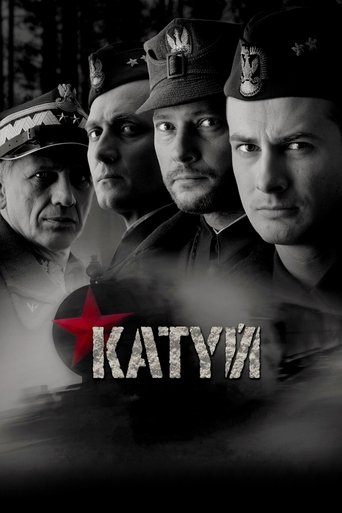
I'm not sure I've ever seen a war film wherein the Nazis and the Soviets actually tried to hold the other accountable for some of the atrocities in Poland, so this film serves as quite an eye-opener. It's September 1939 and the ordinary Polish citizenry didn't know where to turn. Their cities are being bombed to smithereens and what's left of their armed forces is being easily overwhelmed by their invaders. Initially, it is only the officers who are being detained, with the private soldiers and the families being left largely to their own devices. Gradually, though, it becomes clear that this is but an holding operation whilst the prison trains were readied to convey these men to prison camps in the East. "Anna" (Maja Ostaszewska) finds herself in such a predicament when she, and their daughter "Nika", become separated from her husband "Capt. Andrzej" (Artur Zmijewski). At this stage in the conflict, it might have been possible for her to move to the zone occupied by the German military where he parents lived in Krakow, but after being refused a licence three times she becomes more acutely aware of the dangers as she has to rely on a kindly Russian officer to make it to what she hopes will be somewhere marginally safer. In 1943, with the Nazis now dominant in this theatre of the war, they discover mass graves at Katyn which they blame of the now withdrawn Russian forces. Exhuming what is left of the bodies, they carry out "thorough" autopsies and identify many of the murdered men via loudspeakers to their loved ones living in dread that their husbands, fathers and sons would be named. By 1945, the battle had swung the other way and it'd become the task of the Soviet forces to reveal the true extent of the extermination of some 22,000 Polish officers, but with each side having consistently accused the other for the killings, it proves nigh on impossible to know just who was behind these crimes. What are the chances that this family will ever meet again? This is very clearly a topic close to the heart of Andrzej Wajda and by interweaving a poignant familial story with some truly ghastly archive footage of some of the real discoveries at Katyn, it begins to quite scientifically establish just which of these militaristic regimes was behind not only these executions but of just what happened to anyone on their own side who protested or attempted to disobey. It also illustrates something of the psychological trauma faced by both those imprisoned and those awaiting news; the senses of fear and dejection - and all amidst a convincingly presented production that captures the imagery of war and it's concomitant poverty and horror potently. It's a grim watch, made more so by a total absence of hope throughout and it is quite a compelling critique of mankind's ability to be cruel, truly cruel.