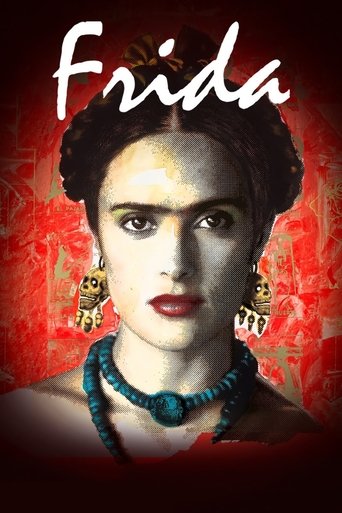
**A good biographical film about one of the greatest American painters of the 20th century.**
I'm not a deep connoisseur of Mexican painting, but I don't think I'm saying heresy if I consider Frida Kahlo the most international and well-known artist in the country, the most notable of Mexican painters. She was considered a surrealist, but she didn't really agree with that because she didn't paint dreams. In fact, I agree with the artist: what she left us, in powerful and dramatic canvases, is a portrait of her life, what she lived, felt and saw.
Kahlo's paintings look simple. She was not an academic, coming out of a very expensive and elegant school. She painted with feeling, with an art that was her own, not a copy of others, nor an attempt to follow any school or any master. She painted with simplicity, emotion and drama, in what we can call a “naïf style”. She was married, in a very tempestuous relationship, to the painter Diego Rivera, but he, although more technically perfect, is not as good as she is because he lacks in emotion and sincerity what he has left in political activism. In fact, what I don't like about Rivera's art is the constant apology for communist ideas. Art and propaganda are different things, although they can be harmonized.
The film, directed in a very elegant and competent way by Julie Taymor, invites us to know the artist's life from her youth until her death. It begins shortly before she suffers the accident that will weaken her for the rest of her life (something the film does not tell us – and it is a pity – is that she had polio as a child). The film focuses on her relationship with Rivera and, later, on her affair with the exiled Leon Trotsky. However, and as the film makes clear, the artist was bisexual and had a lot of extramarital relationships with men and women, like her husband, who had a variety of lovers.
I dare say that this is one of the most solid cinematographic works of Salma Hayek's career so far. The actress gave us a powerful, intense and personality-filled performance. Beside her, Alfred Molina also gives us a strong and charismatic work. Geoffrey Rush, an actor who rarely lets us down, was not so good as the disgraced Russian revolutionary. I found it unconvincing, and the romantic relationship with Kahlo sounds artificial, more like a whim than a powerful attraction between characters. The film also has cameos by António Banderas, Edward Norton and others, but they were misused and accessories.
Technically, the highlight goes to the cinematography, crafted with a lot of creativity: I cannot fail to highlight, for example, the scenes in the Aztec ruins, or that scene where Kahlo is treated in the hospital, with a graphic animation that remembers the artist's paintings. The insertion of the paintings is very well executed, so that we can clearly understand the connection between Kahlo's art and life. The soundtrack, with various themes alluding to traditional Mexican music, does an excellent job, and the recreation of historical times and environments was also done with great care and discretion.