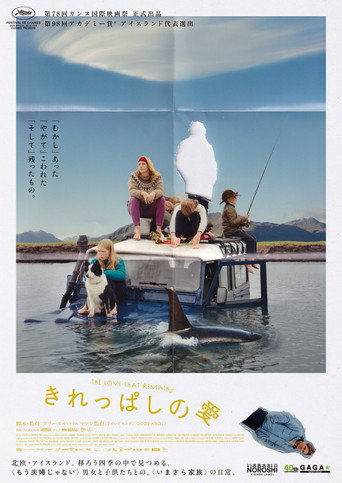
Divorce can have a very strange effect on a family, both for the separating partners and for anyone in their household, especially children. The rules of engagement are in flux, with some events feeling uncannily familiar and others being radically different. There may also be instances of unintended but undeniable backsliding, making circumstances messy, uncomfortable and confusing. Navigating the shifting sands of these conditions can thus be challenging, baffling and upsetting for everyone and in myriad ways. So, given these fluctuating parameters, how is everyone supposed to cope with these unfamiliar scenarios? That’s the turf that writer-director Hlynur Pálmason seeks to explore in his fourth – and perhaps most unusual -- feature offering, a series of diverse vignettes that unfold over the course of a year after parents Anna (Saga Garðarsdóttir) and Magnús (Sverrir Gudnason) divorce and seek to build new lives for themselves and their three children. But are they as ready for this kind of change as they think they are? How will it impact their work lives (Anna as a would-be but long-unsuccessful artist and Magnús as an often-absent deep sea fisherman), their relationships with the kids and their interactions with one another, both emotionally and with regard to lingering and obviously conflicted physical temptations? However, in telling their story, the filmmaker frequently seems almost as perplexed as his characters, as evidenced by an uneven, meandering narrative that seldom results in resolution of the various scenarios that arise. This becomes especially apparent in a number of bizarre surreal sequences that seem almost always out of place and do more to bewilder the audience than provide any sort of meaningful clarity. In the meantime, the director struggles to cover these shortcomings by routinely falling back on the inclusion of an array of admittedly gorgeous but largely inexplicable nature photography segments that look like they’ve been culled from a “Visit Iceland” travelogue, along with numerous shots from Magnús’s working life that appear as though they’ve been excerpted from Chamber of Commerce industrial films. Whatever the filmmaker was going for here, though, it feels like he’s often reaching for something that he never quite grasps, making for a visually appealing but ultimately muddled watch for viewers. Pálmason is a genuinely gifted auteur, but, regrettably, this is not one of his better efforts. Invest your time in works like “A White, White Day” (“Hvítur, hvítur dagur”) (2019) or “Godland” (“Vanskabte Land”/“Volada Land”) (2022) instead.