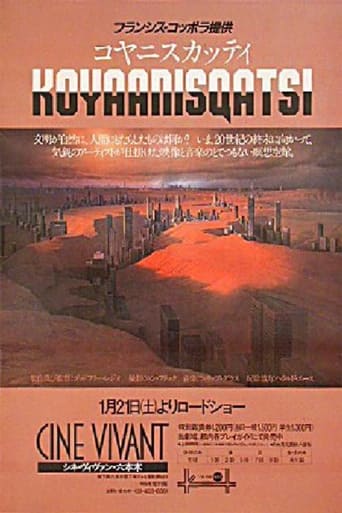
コヤニスカッツィ
あらすじ
高度な撮影テクニックを駆使してアメリカ国内の都市や自然を捉え、文明社会が引き起こす危機を映像と音楽のみで描き出す。
予告・トレイラー
興行成績
製作費: $600,000 (1億円)
興行収入: $3,200,000 (5億円)
推定収支: $2,600,000 (4億円)
※製作費・興行収入はTMDBのデータを参照しています。収支は(興行収入 - 製作費)で算出したFindKey独自の推定値であり、広告宣伝費や諸経費は含まれません (1ドル=150円換算)。
高度な撮影テクニックを駆使してアメリカ国内の都市や自然を捉え、文明社会が引き起こす危機を映像と音楽のみで描き出す。
製作費: $600,000 (1億円)
興行収入: $3,200,000 (5億円)
推定収支: $2,600,000 (4億円)
※製作費・興行収入はTMDBのデータを参照しています。収支は(興行収入 - 製作費)で算出したFindKey独自の推定値であり、広告宣伝費や諸経費は含まれません (1ドル=150円換算)。
監督: Godfrey Reggio
脚本: Ron Fricke / ギー・ドゥボール / Leopold Kohr
音楽: Philip Glass
制作: Godfrey Reggio / フランシス・フォード・コッポラ
撮影監督: Ron Fricke
制作会社: IRE Productions / Santa Fe Institute for Regional Education / American Zoetrope
This is an art film of sorts, eschewing dialogue or narration or a recognizable plot for a visual and musical banquet of images and scenes. So if you are into art films (or want to appear like you are), this is the film for you. The photographic techniques remind me of nature films, which may not be a coincidence since the subject matter seems to Focus on what is seen as being against nature. So it is all here: explosions and collapsing of buildings, a bridge, about five times, even what looked like a nuclear blast; then time lapse photography of city and highway traffic and masses of people walking; plus slow motion clips of masses of people walking; and shots of tenements and abandoned building and kids playing in water from fire hydrants — well, you get the idea. I like Philip Glass’s music, but there were times I didn’t think what they used quite fit what was being shown on the screen. But like he apparently told the producers more than once before they convinced him to take it on, movie scores weren’t his thing. So as the William Hurt character says in The Big Chill, just let the art flow over you. If nothing else, check out the dress and hair styles of folks in the wacky 1980s!
**For the general public, this film is uninteresting. However, it will have merits if displayed within the most correct context.** I've heard of this film as a documentary, but I honestly don't know if Godfrey Reggio really wanted to document anything. This was the director's debut, and for a first work we can say that there is quality, even though it is a somewhat strange film because it has nothing more than a soundtrack and successive images, which do not seem to have a relationship with each other. If this is an experimental film, I also can't understand what this director really wanted to experiment with. Making a film without a script and without a story? Honestly, this film looks a lot like those successive images that are sometimes shown in waiting rooms, for whoever is sitting there. And what about the film's title? I honestly thought it was some Croatian or Balkan film before I read something about the film and ventured out to see it. Only then did I discover that it was a term from the Hopi language, and that it means living in an unbalanced way. Without a defined script, without any actor, without a spoken word (the title is sung in a threatening Gregorian tone at the beginning and at the end, but I consider this part of the soundtrack pure and simple), we just see all the images and the sound of the music. In short, the film seems like a mute critique of the modern way of life, in contrast to what was lived in the past, before industrialization. It's what I think. And a good movie? It will be good as an introduction to the environmental debate, as a reflection film. For the general public who are not interested in debating these issues, it is not worth it.
In the Hopi language, this means a mess or a melée and that’s a pretty good description of this ultimate in observational documentaries. It starts and finishes showing us some of the most stunning and striking natural phenomena from the North American continent before gradually dipping its toe into the world of human endeavour. From some of the most impressive features nature created over millennia to some almost as remarkable creations mankind has erected in a tiny percentage of that time. Whilst not on the scale of the Grand Canyon, there are some human feats that are worth acclaiming here as Philip Glass’s score takes us on this tour. Now I didn’t always love that musical commentary. At times it borders on the soporific, but for the most part it goes hand in hand with some cleverly edited imagery depicting how we can be complementary to our planet and how we can be downright hostile to it. A great deal of creative care has gone into the chronology and the photography here as light, shadow, clouds, glass and some effective time-lapse cinematography shows an evolution of the natural, the industrial and the destructive. You do have to wonder if we’d only take greater care of what we have created and live in a less disposable society, then so much of what we see here that is excessive could be eradicated and our place within the environment of the planet less devastating. It’s a surprisingly effortless watch for ninety minutes and maybe if more saw it, it’s powerful message of striving for greater compatibility might have more impact. I’m not sure the title actually helps on that front. I’ve no idea how to pronounce it, let alone tell folks to watch it - but if you’re reading this and you enjoy big scale drama, then this is hard to beat.