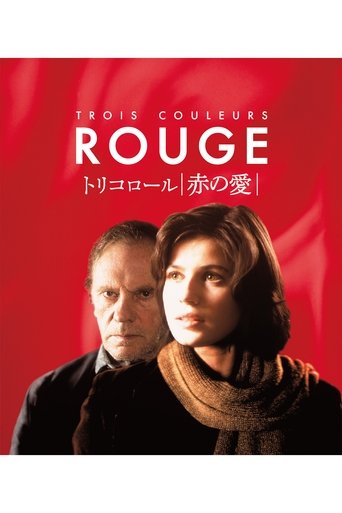
トリコロール/赤の愛

あらすじ
女学生のヴァランティーヌが知り合った初老の元判事には、他人の電話を盗聴するという悪習があった。彼女はそれをやめさせようと、男の過去を探っていくが……。
作品考察・見どころ
興行成績
興行収入: $4,127,033 (6億円)
※製作費・興行収入はTMDBのデータを参照しています。収支は(興行収入 - 製作費)で算出したFindKey独自の推定値であり、広告宣伝費や諸経費は含まれません (1ドル=150円換算)。
女学生のヴァランティーヌが知り合った初老の元判事には、他人の電話を盗聴するという悪習があった。彼女はそれをやめさせようと、男の過去を探っていくが……。
興行収入: $4,127,033 (6億円)
※製作費・興行収入はTMDBのデータを参照しています。収支は(興行収入 - 製作費)で算出したFindKey独自の推定値であり、広告宣伝費や諸経費は含まれません (1ドル=150円換算)。
監督: クシシュトフ・キェシロフスキ
脚本: クシシュトフ・キェシロフスキ / Krzysztof Piesiewicz / Agnieszka Holland
音楽: Zbigniew Preisner / Bertrand Lenclos
制作: Marin Karmitz / Yvon Crenn
撮影監督: ピョートル・ソボチンスキー
制作会社: MK2 Films / France 3 Cinéma / CAB Productions / Studio Filmowe Tor / TSR
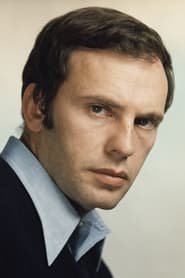
**A very good ending to Kieslowski's trilogy.** This is the last film in Krzysztof Kieslowski's “trilogy of colors”, and focuses on the unusual friendship between a young and beautiful catwalk model and an elderly retired judge who entertains himself by listening, illegally and without no one knows, the telephone conversations of the neighbors. Why? Out of sheer cynicism. He is a man alone, bitter and unhappy. What follows is a trip in which both characters will go through very similar situations. The film continues to have notable points in terms of cinematography, sets and costumes. As in the previous films, the title color is present in all scenes and is persistently part of the sets and props. Despite being elegant, the music is intense, almost a prop for the scene, and contributes to the overall harmony of the work. As in the previous films, the duo of central actors is responsible for an interpretive tour de force, which is absorbing and impressive: Irene Jacob is an excellent actress, but it turns out to be Jean-Louis Trintignant who stands out the most. The script is quite interesting, for the way it explores the cynicism of the judge's character, and for the way it addresses interpersonal relationships, the honesty and sincerity of love and relationships, the application of the law and the moral and philosophical consequences of judgments. humans. There are some details that are a little unbelievable, like how the judge's character evolves from someone resentful and intractable to a more human person in a short period of time. However, it is a film that is really worth it.
Aspiring model "Valentine" (Irène Jacob) is driving home one evening when she runs over a dog. Luckily, it's not seriously injured and after a trip to the vet she repatriates it with the "Judge" (Jean-Louis Trintignant). A quick look around his home though and she realises that he is a snoop! He listens into all the private conversations of his neighbours, records their chats and their peccadillos - all of which is, of course, illegal. Caught between her disgust at his behaviour and her gradually developing affection for the man (and the dog) she finds herself in a bit of a catch-22 scenario. How will that play out when someone reports him to the gendarmerie and his own court appearance looms? Their's is not the only relationship we see here, and using "Valentine" as a conduit, we are exposed to a couple of other people whose issues with loyalty, trust - and fidelity - are there for us to observe and to challenge. Of the three of these entertaining Kieslowski films, I probably preferred "White" - but this is a close run thing. This is quickly paced with humour and pith in the writing and featuring a strong and amiable performance from an on-form Jacob. I did not love the conclusion - even if it did serve to pull the threads together with the previous two films, but if you can see all together in one (marathon) go then I think you cannot fail but to be entertained in a thought-provoking fashion by these stand-alone but interconnected themes of humanity and personality.